Table of Contents
Executive Summary
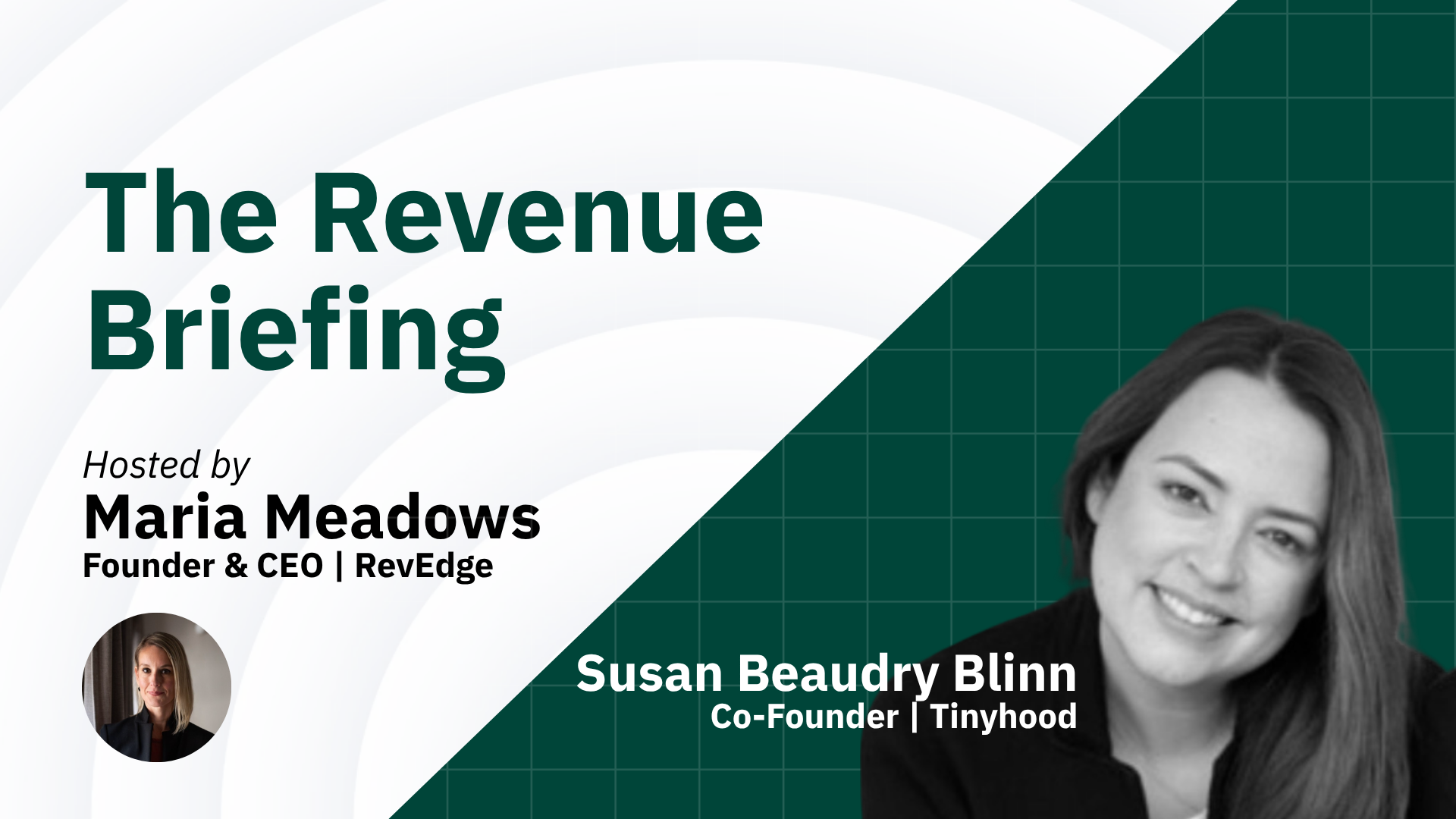
In this interview, Susan Blinn, Co-Founder of Tinyhood, joins RevEdge CEO Maria Meadows to discuss the challenges and lessons of building new revenue channels in a growing startup.
Tinyhood began as a direct-to-consumer parenting education platform serving hundreds of thousands of families. As the company scaled, the team began exploring enterprise partnerships in healthcare and employer markets—introducing a completely new B2B sales motion alongside its successful B2C model.
Susan shares candid insights about what founders often underestimate when launching a sales organization, including hiring the right type of sales talent for the company’s stage, defining clear processes, and understanding enterprise sales cycles.
The conversation also explores how founders can evaluate new revenue channels using leading indicators, funnel milestones, and ROI benchmarks, rather than relying solely on short-term revenue metrics. For startups expanding into new markets, the discussion offers practical guidance on building sales infrastructure, selecting the right tools, and creating alignment between leadership and the sales organization.
Key Takeaways
1. Sales may be unfamiliar for product-led founders—but it quickly becomes essential
Tinyhood originally operated without a dedicated sales organization, but expanding into enterprise markets revealed how critical sales expertise is for scaling new revenue channels.
2. Hiring the wrong type of salesperson for the company stage is a common mistake
Early-stage companies often need strategic sales leaders who can define processes and structure, rather than traditional closers expecting an established sales machine.
3. B2B and B2C go-to-market strategies are fundamentally different
Even when the core product remains the same, enterprise sales require different processes, expectations, and timelines than direct-to-consumer growth strategies.
4. Enterprise sales cycles are much longer than founders expect
Leaders transitioning from B2C environments often underestimate how long enterprise deals take to develop and close.
5. Leading indicators matter more than short-term revenue when testing new channels
Metrics like meetings booked, opportunity conversion rates, and funnel milestones help founders determine whether a new sales channel is gaining traction.
6. Clear pipeline definitions create alignment across the organization
Defining what qualifies as a meeting, opportunity, or stage progression helps remove ambiguity and creates a shared framework for evaluating progress.
7. Sales transparency helps founders make better strategic decisions
Rather than operating sales as a “black box,” founders benefit from structured milestones and visibility into funnel performance.
8. Testing new revenue channels requires patience and disciplined experimentation
Founders must balance giving a channel enough time to prove itself while remaining objective about whether it’s working.
Timestamped Interview Topics
02:15 — Leadership Style and Founder Curiosity
Susan discusses her leadership style, describing herself as an optimistic but deeply involved operator who likes to learn every function before hiring a team.
03:35 — Hiring the Wrong Type of Sales Talent for the Company Stage
Susan shares lessons from hiring an experienced salesperson before the company had defined processes, positioning, or lead generation support.
04:58 — Why Early Sales Teams Need Strategic Leadership
Instead of traditional closers, early-stage startups often benefit from strategic sales leaders who can design the sales organization from scratch.
07:40 — Why B2B Sales Is Completely Different From B2C Growth
Susan explains the major differences between direct-to-consumer marketing and enterprise sales, particularly around expectations and timelines.
09:09 — Understanding ROI and Sales Cycle Timing
The conversation explores how Tinyhood adjusted its expectations around ROI when entering enterprise sales markets.
10:41 — Leading Indicators That Predict Sales Success
Susan explains the importance of measuring milestones like meetings booked, conversion rates, and funnel progression rather than relying solely on revenue.
18:06 — How Founders Should Stay Involved Without Micromanaging
The conversation explores how CEOs can stay informed on sales progress while allowing sales leaders to operate independently.
21:12 — Why RevOps Intelligence Layers Matter
Susan highlights the need for tools that connect signals across systems and surface actionable insights.
22:28 — Running Two Revenue Models at the Same Time
Susan reflects on the complexity of building both B2C and B2B revenue engines simultaneously.
23:22 — Deciding When to Hire Sales Leadership vs. Sales Reps
The conversation explores the classic startup question: should founders hire a sales leader or an account executive first?
26:58 — Advice for Founders Launching a New Revenue Channel
Susan outlines the key steps founders should take before building a sales team, including validating the problem and analyzing total addressable market.
Full Video Transcript
Maria Meadows: Hi. I am Maria Meadows, the CEO of RevEdge, and today’s revenue briefing is with Susan Blinn at Tinyhood. Thank you for meeting with us today, Susan.
Susan Blinn: Thanks. Thanks for having me.
Maria Meadows: Of course. I’m excited to learn more about you as the founder of Tinyhood, but just for our audience, Tinyhood is the leading on-demand parenting education platform.
So think masterclass, but for specifically for new and expecting parents and all parents across all life stages. So I think you have built an amazing platform close to over a million users, it’s just amazing what you’ve built. I’m excited to pick your brain today on how you have built your business on the B2B B2C side, but then also transitioned a new channel on the B2B side of things too.
So particularly how you have done so and how you have thought about revenue as, a key growth channel for your organization. So before I dive into my questions, um, would love to hear a little bit about you and kind of how your role has evolved at Tinyhood and your background.
Susan Blinn: Absolutely. Thank you, Maria. So I’m Susan, the founder and CTO of Tinyhood, and I’m also the president. So Becky and I kind of co-CEO a lot of the aspects of the company, my background as well as Becky’s is actually in technology. So I grew up as a coder, programmer, and, when I started Tinyhood, that was my main role, was just to build the product.
And of course, as you grow a startup, you start putting on a bunch of different hats. So I put on my finance hat, I put on the product hat, I put on the marketing hat, and I’ve kind of had to adjust to the needs of the business. My style’s a little bit more in the weeds. So, um, instead of just hiring somebody, I like to kind of learn the, the demographic, the area that I’m gonna be focusing on before I bring on a team.
Maria Meadows: I think that’s actually brilliant. Um, and, and is a nod to your leadership style. And I think any good founder and leader just really needs to understand. I think it’ll just better position you to enable the organization. Is that how you would describe your leadership style or, um, what if someone were to describe you on your team what do you think they would say?
Susan Blinn: That’s a great question. I guess it would be like the technical term of like authoritative a bit. I don’t love that. I’m, I’m eternally optimistic, but I think if you were to ask everyone on the team I’m quite in the weeds a lot of the time in the beginning. ‘Cause I’m mostly just very curious. Um, I love to learn new things, so I would say probably authoritative.
Maria Meadows: I love that. Tinyhood’s not your first company, right?
Susan Blinn: So it’s not. Tinyhood’s the first company that I’ve founded. But I’ve worked at previous companies, previous startups.
Maria Meadows: Okay. So throughout your career, how have you viewed the role of sales in the early stages? That’s great.
Susan Blinn: It’s so interesting because sales was probably the last piece of Tinyhood that was kind of put on and I would say the most, the least familiar I was with it. And I would say for the be most of Tinyhood, we never had a sales representation. And I think I never really understood for a direct to consumer company, at least the role of sales.
But in hindsight, now I realize how critical it was and I’m like, oh my goodness, we should have done this so long ago.
Maria Meadows: How has your view of sales changed as your business has grown? And then also how do you decide what resources that you needed on the sales side?
Susan Blinn: Absolutely. So when we started moving into exploring the B2B space, selling to enterprises, actually the previous startup I was at had quite a large sales force because we were selling to enterprises at the time. But again, I was on the technology team, product team, so kind of siphoned away. They were also in the New York building.
I was in Boston, so I kind of never really saw that side of the house. And the way that I always thought about sales, like when I first started Tiny Kid, was, you know, this is for selling enterprises and also, you know, you don’t really need a sales team until kind of you’re further along. So the, the, when we started exploring B2B where we looked at a classic sales person who happened to be in the area that we are looking to sell to and I, I didn’t realize there were so many different types of sales.
Leadership, sales colleagues. And I think in hindsight I would’ve thought a little bit more carefully about the different types of sales that you could have on the team. And I think we might’ve brought on the wrong team for the, the stage that we were at.
Maria Meadows: That’s such a great point, and it’s something that we advise founders on all the time too, is just thinking about what type of talent and skillset do you need at which stage, and I think there’s different sales leaders and sales.
Executives that are better suited for different stages of the business. So can you dig into that a little bit more? So when you think about the resource that you hired, what would’ve been an ideal hire resource in hindsight, for the early stages?
Susan Blinn: Absolutely. Um, so given the background of both Becky and I in the product world, I think we would’ve.
Much would’ve benefited from somebody who was more of a strategic, um, leader in the sales space versus a traditional sales person. Um, because we just didn’t have that background. Of course, we like. Research did everything we could, but we, by trade, we’re not salespeople. So in hindsight, we really needed somebody who was more strategic, who could help define processes, help kind of explain how a sales organization should be built from the ground up and where you should start.
And what we had hired was. Um, a traditional salesperson who’s phenomenal who expected us to have a product that was defined, a process that was defined. Uh, we didn’t even have somebody at that time when we hired them to kind of do the lead gen there. There’s just things that we were missing that I think we need a little bit more guidance on.
Maria Meadows: Yeah, that is such a great point too, because I think you have, uh, some really good talent that can walk in the door and just fall victim to bad processes or just in undefined processes, and I don’t think that’s anyone’s fault other than. It is just who’s the right talent for the right stage? And it’s something to think about too on from a sales talent perspective of, you know, what their skillset is, but what tools and asset and support do they need at to be successful.
And we see a lot of turnover in the early stages just for that very reason. We don’t know yet, right, so we think about the type of talent that needs to come in. It’s gotta be a little bit more fluid and strategic to your point, but. Not, it’s a balance, right?
So you’re, I almost use the word scrappy and resourceful. Um, and someone that, and I think it’s a question that I hear often and we think about for any startup is how much do they need a process? How much do they need experience in this space? How much do they need to be really great sales and closers. And it’s kind of a blend of all of it, right? Yeah. But um, you know, you may get a really great closer that needs defined collateral and a clear go to market.
Susan Blinn: And we did not have that, not even close.
Maria Meadows: Well, it evolves.
Susan Blinn: And it’s funny because, um, I feel a lot of founders feel this way about tech and like hiring a tech.
But Becky and I are like, I could hire tech people. Like I understand the timelines, I understand the process that is like, I can do it in my sleep. And then I’m like, oh my goodness. No matter how many advisors we talked to about sales, if you’ve not done it yourself, it’s really difficult to get the hiring correct, I would say.
Maria Meadows: Well, and it’s also interesting in, in your dynamic, because you, you started on the B2C side mm-hmm. And you built a sizable model on the, on the B2C side. And then now you’re launching a whole new channel on the B2B side. Right. So, uh, it. It doesn’t transition apples to apples. No.
Susan Blinn: Not even close.
Maria Meadows: Yeah.
Susan Blinn: I mean a lot of aspects do. The technology is almost the same.
Maria Meadows: Yeah.
Susan Blinn: But everything from the support, the process, the go-to market Strat, it is completely different. And even the expectations I can turn on. A campaign on the direct to consumer, and immediately I’m seeing revenue come in. I think it was shocking for me that sales cycles are just so long in the enterprise, but it makes sense in hindsight.
So you, we really didn’t give, I would say the sales team that we had brought on enough credit, we didn’t understand. We just wanted immediate results and I think the lack of understanding of what a sales cycle looks like really hindered us. So,
Maria Meadows: That it, that is such a great point that I just wanna take a minute on because there, it tends to happen often where, uh, numbers are built and they’re given to the board and there’s sometimes, and oftentimes a misalignment between the sales cycle and then the forecast.
So I do feel I, and I have the privilege of working with you too, that you are very analytical and you do take the time to understand, which I think. Helps and it helps ground the business and it helps set the business up for success and, and find ways to give the space for different channels to be successful.
Can you spend some time talking through what metrics you focus on, kind of how you oriented yourself to the B2B space? Just to make sure you’re managing your advisors and your board’s expectations appropriately. And also setting the sales team up for success and giving them the tools they need to be successful.
Susan Blinn: Absolutely. And just to give a little background of where we started with the direct to consumer, you know, we really were focused on an ROI play based on the amount of marketing dollars we spent, the amount of employees we were paying to kind of run those marketing efforts. And again, I could see that ROI Daily, weekly, monthly, immediately.
And I think when we, um, had our first sales organization, we realized that that’s not how it was working with your team. I knew that we needed to. Um, hire a leader who could kind of explain what’s the sales cycles, what’s the ROI and how is the ROI gonna come to fruition? So for me, I still look at the ROI, but it’s a little bit more delayed, I would say.
And also more in general understanding. Some channels and sales have a longer sales cycle. Some have more, some start slow and then they like stumble. So just. Kind of thinking of it as a long-term ROI play, I’m willing to invest this much money to explore this channel and to be honest, putting money aside where that channel may not work, but I want to make sure that we’ve given it all before we decide it’s not going to work.
So the main drivers for me are obviously profitability. So the stage of the company we are profitability is key. So in lieu of longer sales cycles, I’m always thinking about, okay, what else can we do in another channel that could provide supplemental income to keep us at a profitable state of a company?
Maria Meadows: I also wanna focus on that. So while ROI is the north star, we know that, right? That’s just for any business. I think you’ve taken it a couple levels deeper in terms of what are the leading metrics that I need to focus on as a founder?
Susan Blinn: Absolutely.
Maria Meadows: To know that the business is moving in the right direction, right?
Because you don’t wanna call it too soon and pivot too soon where you haven’t given a chance, but you also don’t wanna run, keep running and, and have an emotional bias toward a channel that may not be working. So can you spend some time talking through, I, you know, we, we know the top layer metrics that we’re all aligned to as founders and CEOs, but the one or two numbers underneath that, you’re like, this is what I’m asking for the sales organization to communicate to me on a, a monthly and quarterly basis to know that there is a, there, there for this particular ICP and go to market.
Susan Blinn: Absolutely. And I’ll say this is something that your team has really helped me learn more about. I think the things that I’ve pushed on in our relationship was really just more of these milestones, uh, and not necessarily revenue milestones, but what are the leading indicators as you describe through each phase of the cycle, um, based on a conversion rate.
So how are we, let’s say the first few funnels have certain coverage rates, like how are we doing compared to those and um, being able to understand those checkpoints so we’ll know by Q2 whether this particular part of the funnel is working. Yes. And that to me and I, I know it’s also tricky for a sales organization to be able to promise certain milestones when, when it’s a new product offering.
We don’t know. But it’s really helpful for me to have a benchmark of. Where I can just take a deep breath and say, okay, I know the revenue’s not here, but I can see there’s specific milestones, like meetings booked interest, different things that we’ve defined as, um, various benchmarks have been helpful to be able to say, okay, this is, we’re on track this quarter.
Despite potentially like not having revenue and cash and bank.
Maria Meadows: Yeah, where it’s a luxury working with you as a founder, um, with your background too, is that yes, you know, you may not come from the sales background, but you really push the sales organization to put some goals in place that are, you know, are underneath the number.
And I think that’s, it’s hard because you don’t know, you’re making assumptions and you’re having to pivot, but it’s, you’ve created a safe space for the business to just anchor to those metrics and have an open and honest discussion on. Are we there or are we not? Is it too soon to call it or not? And so it, it does take a particular level of talent that is okay in this unknown.
I mean the, and, and focus on some of these leading indicators that I think, um, helps you be more predictive and proactive about setting everyone up for success in the business so it doesn’t feel like a failure, right? Because when you’re testing new verticals and new. Customer profiles. Right. So to your point, and I, I don’t wanna lose that on the audience.
Tinyhood’s not new. It is a proven product that has an amazing amount of engagement and impact for working parents across all life stages. Right. It’s the fact that now you are looking to diversify your revenue and expand to other channels that you’ve never tested before. And so that. For every channel, there’s a very different sales process, go to market messaging, and I think it’s very easy for anyone to put numbers on the board and say, this is what our goals are.
But where you’ve put a lot of time is, okay, what? What are these leading milestones and numbers in terms of meetings completed? Um, from meetings completed to opportunities converted, and how do we define each of those? So you’ve pushed the business to put a lot of definition behind each of the stages and the trigger so everyone’s aligned to say, okay, we all know that when an opportunity moves from this stage to the next stage, this is how we’re defining it, right?
These things have happened, and so it kind of keeps everyone aligned, but it also creates a safe space. Absolutely. For everyone to say is, is it working or is it not? And, and I think that’s a lot of empowerment to the business and organization that sometimes you don’t see, sometimes you see some founders just treating sales like a distribution channel, number.
Susan Blinn: No. I mean, to me sales is like our number one.
Maria Meadows: Yeah.
Susan Blinn: Or right now it’s happening. I will say that, you know, we’ve done, we’ve made mistakes where we’ve kind of kept sales in a black box where. We’ve been told, okay, it’ll take 12 months. And it’s kind of like, let me do my thing goodbye. Yeah. And at the end of the 12 months, you’re what’s going on?
And, and again, it’s not, the milestones are not meant to micromanage, it’s meant for understanding for myself because I would like to learn all along the way, and I actually don’t see as a failure if we decide, you know, nine months into the third milestone, it’s not working. Yeah. To me that’s a success.
We’ve successfully figured out that. This is no longer gonna be a priority, we’re gonna move here. What the mistakes that we’ve made in the past is where it’s kind of fuzzy, where we’re not really sure one way or the other. To me, it’s like, let’s just put these milestones in place so that we can learn whether this is moving forward in the right direction or not.
Maria Meadows: And then what tools do you have, uh, sales tools that you’re using currently?
Susan Blinn: So currently we’re using HubSpot, which I absolutely love, and I will say we’ve used HubSpot for three years now. And until your team came in and set it up the correct way, I would say I didn’t realize how powerful it was. And I think that’s probably most technology vendors out there.
If you’re. Products can be quite powerful if used appropriately. And so I would say that’s another mistake that we made is we were not using HubSpot in with the previous sales or in the way that I felt like was understandable to me. There was no dashboards. I, I couldn’t see what’s going on.
Maria Meadows: Yeah. So let’s, can we talk a little bit about dashboards?
Because you are so metrics oriented, you do have your own Excels and systems, so you’re tracking in a couple different places.
Susan Blinn: Yeah.
Maria Meadows: If you could change the way you were receiving information or getting information, if in your seat with everything that you oversee and your background, what would be a couple metrics that you would like or prefer to get that you’re not getting now or in a format that you’re not getting now?
Susan Blinn: That’s a great question. That’s a great question. I love Excel sheets, as you know, by now, I think HubSpot is amazing in, what it does, what I think it might be missing, or maybe we’re just not using it because I haven’t asked to use it in this way. I think I would more, we have like these quarterly milestones.
I would love to be on a weekly where I’m really getting it, but at the same time, maybe that would be just too much. I guess that would be the only ask would be like, is there even like something more granular than the quarterly that we could use as a base? Yeah. And I think you and your team are using that.
It’s not necessarily privy to me, I guess I would say. Yeah.
Maria Meadows: It’s not always coming up to the ceo.
Susan Blinn: Right.
Maria Meadows: So what would you wanna see then?
Susan Blinn: That’s a good que I don’t know, honestly. Um. I dunno. I think right now we see like the monthly breakdown of all the things in the, you get the outcomes I get the monthly
Maria Meadows: and you get a forecast, like an updated, like are we gonna hit?
Are we not? Yeah,
Susan Blinn: right. And maybe I don’t need to see anything, but I guess being like a data person, I would love to see weekly over time just to see how we’re trending. But I will say when we meet every week, you kind of provide that insight anyways. It’s just for me being able to like read it and see it as a historic
Maria Meadows: It’s interesting because.
So the weekly change, depending on what’s on everyone’s mind or on deck for the week, right? So you think about a cadence with a sales organization. You’ve got your weekly meetings, you’ve got, you know, a monthly summary to some extent. But for the most part, depending on the channel, a quarterly deep dive or a business review, which is really a look back.
And so those weeklies can get, dig into pipeline. Sometimes they’re account focused, right? Um. So this is where it’s like how it’s hard to balance all the different topic areas that with limited time from a CEO standpoint, right?
Susan Blinn: It’s almost, yeah, totally.
Maria Meadows: So to your point, like sales, we’re in it every day.
We know and Right, but you’re running and wearing multiple hacks across the organization. So you get, let’s say an hour with a sales team a week to check in.
Susan Blinn: Mm-hmm.
Maria Meadows: It, and this is for any sales organization, especially one of your size too, candidly, but across any organization, some weeks it’s a big account that mm-hmm.
We’re either prepping for or debriefing on and need to talk about next steps. That’s gonna have a huge impact. Some weeks it’s going through the whole pipeline of process.
Susan Blinn: Yeah.
Maria Meadows: Some weeks it’s going through sales tools and here’s what we would like to have.
Susan Blinn: Mm-hmm.
Maria Meadows: So. Taking all that into account, right?
You’ve got deal updates. Sometimes you’ve got pipeline updates on a weekly cadence, right? Um, if you had to like say, this is where I would wanna get involved in the perfect scenario, once we’ve proven the channel out and we’re kind of humming, this is where, these are the most important parts of the business that I wanna make sure I’m looped in on without replacing a sales leader or, ’cause the reality is, it is, there’s a reason, it’s two different jobs.
Susan Blinn: Absolutely.
Maria Meadows: So like, no, you can’t be in everything and it’s just not realistic or practical. But you do need to be involved to an extent where your brain is invaluable to the sales organizations. You know, the product deeper than anyone else.
Um, you help unlock opportunities, either even from a pricing standpoint. Um, and I, I can speak to that personally with you. So taking all this into account, taking a step back what would be the most important. Updates. Is it, are we pacing to the metrics, right? We said like, is that would be the most important to you?
Susan Blinn: Yeah, I think it would be any metrics. So like, let’s use the meetings book, but that’s a simple
Maria Meadows: Yeah.
Susan Blinn: Milestone, right? We’re hoping to get 42, let’s say we get anything that I potentially could apply more resources on to help. Resolve. I would wanna be alert, and I think you guys did alert me by the way, um, I would wanna be, you know, this week, all of a sudden it’s like we’re feeling like, you know, we have one month left in the quarter, we feel like we’re kind of low.
What could we do? And that being a flag, like, hey, I think we’re about to that week. Like how about you try to like, get your marketing team to help us, blah, blah. And by the way, you’ve done all this, I’m just giving examples of No,
Maria Meadows: but it’s
Susan Blinn: a great point. If it were to be automated, it’d be like, that week would be yellow and it would be, we could use some help from the rest of the team to kind of.
Or we may decide, you know what, it’s okay. Let’s we’re actually now focused on something else, which is what we did partners. So let’s not worry about the fact that we’ve had to readjust that number.
Maria Meadows: Yeah. Look, I the beauty in this interview is that you kind of got a CRO brain and a CEO brain sitting here, right?
Um, in terms of how we’ve operated together. And so what I think is important is that while we all intimately understand and we know that we’re communicating, it’s almost kinda like a fly. Like it’s yes, we got that Tuesday meeting, there’s a 15 other things, right? And so. I think it’s a very valid point to be like I, it’s not that the sales team is not reporting on something or not flagging issues, it’s almost as proactive kind of update that better positions you to solution.
In your own time versus waiting to do it live in a Tuesday meeting or, uh, af follow up afterwards. I think it’s a very valid point.
Susan Blinn: And I think you, you’ve done this already, it’s just more of you’re talking about wanting to document that Yeah. Somehow automate it.
Maria Meadows: Yeah.
Susan Blinn: I don’t know how you would do that, but that would be the automation flag of like, Hey, we’re looking like we’re trending.
Do we wanna keep this way and keep our priorities or do we wanna stop? And again, you’ve done that. Um. Yeah,
Maria Meadows: no, I, um, and it’s also, I mean, candidly, it’s why we’re building rub edge. I mean, it’s exactly what this platform is meant to do because we’ve worn the different hats and we see that even your best teams that have the best communication and the best collaboration, it, it still is everyone is.
There’s only 40 hours in a work week. And so like your head’s down executing, you’re, you’re pulling your head up, you’re working on strategy, you’re back down. And so if there’s this like intelligence layer, which is what Rev Edge is, that’s supposed to connect all the dots,
Susan Blinn: that’s
Maria Meadows: great. I think that’s where the biggest discrepancy has been.
Even for metrics oriented leaders like yourself. It’s, doesn’t mean you can’t get to it, but that takes time to fit, to not only pull it, but think about it.
Susan Blinn: Yeah.
Maria Meadows: And then, uh, activate on it. Now I wanna go back to looking back. You’ve launched two different channels, which are very hard.
And I can speak firsthand and I, we’re not there yet, but you have proven out and there’s a lot of really great signals that you do have a successful B2B channel too, in addition to B2C. That is not an easy. Thing to do for a founder to run two Totally different
Susan Blinn: market. Yeah. It feels like it. Two, yeah.
It feels like it’s two different businesses, but it’s
Maria Meadows: it’s two different businesses. Yeah. And with a very lean team. So as you think about the future of sales how are you thinking about resourcing or tooling? And, you know, what mistakes are you gonna avoid that you’ve kind of made in the past?
Susan Blinn: I think we need to have leadership full-time on the team that is focused on sales. Again, I can. I learned a lot from you. I see a lot, but I think my whole career has been technology. Like I can’t imagine not having that background information of just like, so I think we’re, what we’d like to do is really kind of bind that leader that’s in-house that can just be my counterpart from technology standpoint to the sales to kind of make sure ’cause I, I don’t foresee sales slowing down.
If anything. That’s basically our highest growth area is gonna be in these sales.
Maria Meadows: So, we get a lot of questions when. Scaling up, do you start with a sales leader? Do you start with a senior account executive? Do you start with a sales development representative?
Susan Blinn: Yeah.
Maria Meadows: Where do you start? Because the, you just for the benefit of the group, you’ve hired a consulting firm to help, which is the resident agency to help kind of prove out a model, and then you’re planning to bring it in-house, right?
So you’re trying to de-risk as much of, of the segment as possible. But the ultimate goal is you’re gonna bring in your own team, but a question we get often from the consulting side is, where do you start? Right? Because if, if you need to continue the momentum with revenue, you bring in a sales leader, is it a sales leader that’s also carrying a bag?
Susan Blinn: Mm-hmm.
Maria Meadows: Or is it a sales leader that’s helping build out a team? How are you thinking about Absolutely. There’s no wrong answer. I’m just curious. Yeah. You’re thinking about it
Susan Blinn: and I, again, I think working with you and your team. Has, again, brightened my eyes to all the different types of sales professionals that are out there.
Maria Meadows: Yeah.
Susan Blinn: I think if in a perfect world it would all depend on the fractional help that we have. So in my opinion, you are that fractional executive leadership. Yeah. And I think if we were ever to wind you up, I would need that leader to be someone just like you. And I think it all depends on, I know we’re, we’re coming up with a plan.
I think it’s really dependent on how I teeter off fractional help or not. Yes. Yeah. So in my opinion it seems to make sense to maybe not hire that top sales executive first and instead work with you to kind of help us train the other sales team and then eventually find that top down.
Maria Meadows: Yeah. Yeah. It’s hard because, you’ve taken an approach where it’s a fractional resource that’s gonna help build a process and prove out that process, which then doesn’t, in theory, make it easy for a senior account executive to come in and have a playbook. Yes. And then the whole business is trained and, and familiar on execution.
Right. Um, but if you’re a founder that maybe starting from scratch and even just moving away from founder-led sales, there’s a question, do I start with a sales leader to help define it or,
Susan Blinn: yeah.
Maria Meadows: What, how do we define that process? I will tell you it, it’s expensive to hire a senior account, you know, a sales leader at the same time.
While a senior account executive may feel on the ground, tactical it can’t be expensive based on a long ramp time.
Susan Blinn: Mm-hmm.
Maria Meadows: Right. Um, delayed revenue and them just trying to figure out a process. So it’s kind of like a chicken or an egg for the business. And I think, I don’t think there’s one right answer depending on where you’re at.
But I do. And I think you and I are cut from the same thought that way. I think having a process and a clear understanding is one of the most important things to do. Um, but I don’t see that with every founder. I think some founders are focused more on let’s close a big whale and then figure it out for there.
Susan Blinn: Yeah. And, and look, I mean, we have dabbles in different channels and I think for me, I’m also trying to optimize for learnings now so that when we do come time to hire, like it’s in the right area of all, I know all most sales executives can kind of handle areas, but
Maria Meadows: yeah.
Susan Blinn: The healthcare world is so much different than the employer world.
So trying to figure out as much as we can learn ahead of time to help us, um, perfect. That hire, I would say would be, is my goal.
Maria Meadows: Okay. So, uh, I’m mindful of time, but I have a couple more questions for you. Sure. You were even doing research in this channel before you even reached out to the residents agency and Dave Carrigan at Benefit Pitch Rate.
You have built a network. So can you walk us through a little bit about if you were to give, uh, advice to a founder who is thinking about launching a new revenue channel?
Susan Blinn: Yes. What
Maria Meadows: do they need to do before they even think about resourcing?
Susan Blinn: Absolutely. The first thing I would say is so we, the only reason we moved into B2B to be honest, was because we saw that there was a real gap in getting access this education, access to all parents, because 40% of parents are on Medicaid.
So we already knew in the back of our mind. So understanding why you’re thinking about potentially gonna BD is like step one. What’s the reason? What are you trying to solve? Yeah. What problem are we solving? It’s not just money, right? Oh, what’s for money? It’s like, what are we, what problem are we trying to solve?
Um, I love that point in the business. Then we had a lot of indicators where we were having inbounds to us. We had a couple of large health plans reach out to us, a couple of health systems saying, Hey, we’d love to offer this education for free to our patients. And so then we had a little bit of validation there and we executed those.
I think the mistake that we made, to be honest, before we went dive to hire our first sales teams, we didn’t really look at the total addressable market to kind of, we kind of just followed the inbounds, which again is not a terrible situation, but I would’ve looked at, the total addressable market.
And so we did that for the employer space before. And to be honest, one of our investors advisors has been telling us to go after the employer space for years. But yeah, I, I would make sure to understand the total addressable market and the timeline. So the sales timeline. So are you looking at, um, 18 month cycles?
Are you looking at nine month cycles? Are you, and then how do you, if you’re just B2B, you have to understand where are you gonna have revenue to fund the business. Yeah. Why you wait through that. So for us, we have our direct to consumer business and our sponsorships sales to help us fund the business.
But again, planning the total addressable market, how long, total, and then what is the size of the first contract? So in healthcare, typically they’re like pilots. They’re smaller. I mean, it’s not a small amount of money, but it’s not, it’s a little bit smaller money, then you get a little bit more here.
Yeah. So then when we plan for employer, it’s like, okay, we understand the total addressable market here. We understand how big this can get and how fast and how it can snowball. Um, just planning those things ahead of time. And again, not to micromanage the plan, it’s better to just move forward. But I think when you’re dealing with long sales cycles, you wanna be really thoughtful about which channels you go after.
’cause if you go through all of them at once, you’re just gonna fail at all of ’em.
Maria Meadows: Yeah. No, I, I mean, look, I can speak to this ’cause even when, when we were connected, and we typically do this anyways, but I think it, you helped us take this to the next level of thinking through, even in the propo like scoping stage of deciding to work together of like, let’s put some assumptions in around conversion ratios, like right.
And then, and we’ve evolved it, but we still reference it like, how Right were we, were we off here? Yeah. Or are we over, over, you know, overindexing in this area. So, even. Being okay. Putting pen to paper and saying, yeah, hypothesis, assumptions on the funnel conversion. We can recalibrate from there. But then I, I thought that was brilliant.
Um,
Susan Blinn: yeah,
Maria Meadows: and you had us work it a couple times, even on a conservative standpoint. ’cause it’s very easy emotionally to be like an ego. So it’s gonna be great. We’re gonna close this and it’s gonna be right. Yes.
Susan Blinn: And I would recommend if you’re a founder who does not have a sales background, to not attempt to do that on our own.
I really think you need to have people who are in that specific channel industry what their assumptions are because it’s helpful and you can always get more conservative or more aggressive depending on how you feel. But to ask someone who’s in healthcare sales to. Decide what the funnel should be for employee, it would just be, it’s not a great idea.
Maria Meadows: Yeah. Well, and everyone brings such a different perspective, right? Yeah. Um, I’ll give a shout out to Dave Kerrigan at Benefit Pitch. I mean, he knows the space so well, so he kind of helps think about it from a strategic go to market standpoint. And then you tapped into sales resources to be like, now walk me through conversion.
Like
Susan Blinn: Yeah.
Maria Meadows: How many phone calls do you think it’s gonna take? How many meetings? And, and again, there’s, there’s a lot of generalized information out in the market. So like, you can get to this information and be like, okay, baseline. What does it look like? But then where it needs to evolve is what are our actuals?
Like every business is dynamic, every channel’s dynamic. And we do have a couple different yeah. Plays in motion, right? So it’s looking at it combined separately. And I think that that drives the conversation from a strategic standpoint for the business. And it’s not just about,
Susan Blinn: yeah,
Maria Meadows: deal level conversations with sales.
It’s, yes, that’s important too. And there is a lot of conversation there, but it’s also at the same time, like right. The funnel at each stage and how do we unpack it?
Susan Blinn: Yeah. And also just to realize it’s, it’s really, sales is just one part of it. That’s true. Um, like we’ve had to evolve our product messaging, our, even the product itself, I, it’s gonna be evolving, so based on everything that we’ve learned.
So just being a. Basically very flexible as you journey down B2B, that it’s not gonna be the same. I mean, it seems like the product’s the same, but there’s just, the messaging is gonna adapt. Everything’s gonna,
Maria Meadows: that’s true.
Susan Blinn: Need to adapt. So being able to, to do that as well.
Maria Meadows: That’s a great point. Um, okay, so there is a lot, selfishly, I wanna ask you this question.
There’s a lot of AI capabilities coming to the market, a lot of rev ops tools and you’re in the seat of running the organization. So I’d be curious, just how many outreaches do you get of different. Tools being pitched to you, how do you make the decision on which ones are valuable for you?
Susan Blinn: It’s a great que I must get a hundred vendor emails a day.
Mm-hmm. So, which is why sometimes I lose my emails from you all. But to be honest, I we’re being at this company, we’re being departmental at this point. So right now we focus on the engineering department. Uh, our next department is marketing as we, so it’ll be depart departmental. Yeah. And then once we’re in that department, when I see vendor emails that reflect that I will pursue them and look into them.
But for me, i, if I’m seeing something related to support, I’m not looking at it today. I’m like, I can’t address that today, because each piece is, so I think when you mentioned this new product, I got really excited. Yeah. Rev badge because I mean, I just also know that any product you recommend is gonna be top notch.
I’m excited.
Maria Meadows: No, I think, I mean, look it’s, we’ve been in this seat for so long that even your most analytical. CROs and your process driven CROs still have limited bandwidth and right. So this connective tool between the executive team to better enable the organization, I think is a win-win for everyone.
Um, so how do you decide what tools you need then? Uh, even on, let’s just talk engineering, ’cause sales, you’ll ask your sales partners. You may ask your marketing team, but. Do you tend to flex more in the space that you’re comfortable with and vet tooling there, or do you try to
Susan Blinn: Oh, no, no. I, I, given how I’m really in everything, I see a lot of the pain points across all the business.
So I’m, I’m running the finances, the marketing, I see it all. Um, to me it’s been capabilities of the tooling out there. The engineering aspect of AI is just to me way beyond all the other departments. So that’s kind of where we’ve leaned in on. Um, I also think about the roadmap and the pipeline of what the company needs to do, and I see the upcoming bottlenecks, so I’m trying to, not over like overscale at this point, but just to prepare for, um, what’s gonna be needed in the next three to six months.
Maria Meadows: Okay.
Susan Blinn: Yeah.
Maria Meadows: And then what’s your take on the ai, um, messaging for every tool? How much, what
Susan Blinn: do you mean by a, what do you mean by that?
Maria Meadows: I, there’s a lot of bloat in my opinion in the market and a lot of folks claiming. Every, there’s a scramble to make every tool and every workflow AI driven. And so how do you vet, how much is marketing messaging versus,
Susan Blinn: oh, you know, me, I’m always an ROI, you know, now that I, when I onboard new vendors, it’s always with an ROI and.
I’ve gotten guarantees of it. They say, I promise X, Y, Z, and if not, you don’t pay. So that’s been kind of where I’ve put my foot down with vendors. If you really, truly believe this is going to do that then commit to that promise.
Maria Meadows: Yeah.
Susan Blinn: And I go, of course not all vendors are gonna do that, but. That’s also a very fast way for founders to say yes.
It’s like, okay, why not? If it’s, you know,
Maria Meadows: what’s the impact to my business? Yeah. It’s also a best practice for selling is like, think about it in terms of the joint business case and outcomes that you’re gonna drive,
Susan Blinn: right?
Maria Meadows: Versus like the features and benefits of your tool. Right. Align it to that organization.
Smart of you, that you’re probably just helping a lot of people become better. Yeah. Founders and CEOs. Just with that question alone, it’s like you really need to think about how does this apply,
Susan Blinn: right?
Maria Meadows: I love that. Thank you so much for your time. I, I, of course, I, um, am mindful that what now I’ve kept you over an hour, but, uh, I selfishly, like I’ve had the, the privilege of working with you.
I think you’re an amazing founder I’m so excited to see what Hood’s gonna do and what you’ve built is definitely, uh, just very aspirational for any founder building a business to be like, wow. Um, and to now be in a position where you’re launching different channels. It’s huge in how you’re thinking about it, so I definitely encourage, if you’re open to it, anyone reaching out to you to learn a little bit more, pick your brain on.
Susan Blinn: Absolutely. It’s been fun.
Maria Meadows: I love working with you, Susan, and thank you so much time to answer these questions for us.
Susan Blinn: Well, thank you, Maria. Talk soon.