Table of Contents
- By the Time It Shows Up in a Forecast Call, It’s Already Too Late
- What “At-Risk” Actually Looks Like in a B2B Pipeline
- 7 Signals That a Deal Is Quietly in Trouble
- How to Audit Your Pipeline for At-Risk Deals
- Why Your CRM Won’t Warn You About At-Risk Deals
- The Leader’s Role: Knowing When — and How — to Step In
- How AI Changes What’s Possible for Lean Revenue Teams
- Stop Finding Out Late
By the Time It Shows Up in a Forecast Call, It’s Already Too Late
Most deal risk doesn’t suddenly appear — it builds quietly over weeks. By the time it surfaces in a forecast call, the outcome is usually already decided. The problem isn’t visibility, it’s knowing where to look before it’s obvious.
What “At-Risk” Actually Looks Like in a B2B Pipeline
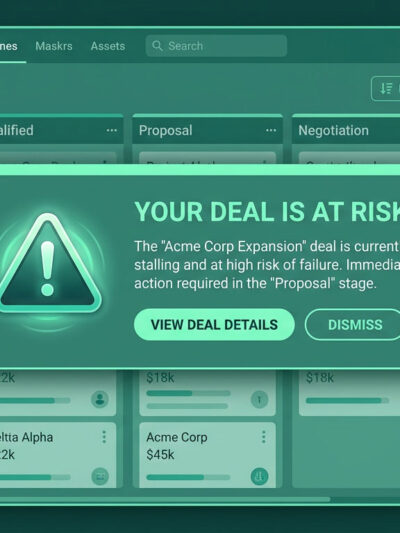
At-risk deals aren’t defined by a slipping close date or a late-stage stall — those are symptoms. Real risk shows up in behavioral signals: how buyers engage, how decisions progress, and whether momentum is actually real.
For example:
- A deal sitting in “Commit” with declining engagement
- A late-stage opportunity with only one active contact
- A strong champion who suddenly goes silent
These are early warnings — not captured cleanly in CRM fields, but highly predictive of outcomes.
7 Signals That a Deal Is Quietly in Trouble
1. Engagement is dropping — and the rep hasn’t flagged it
Activity slows down, response times stretch, and meetings become harder to secure. When reps don’t proactively call this out, leaders often assume things are progressing normally — until they’re not.
2. You’re single-threaded (one contact, no buying committee)
If your deal relies on a single stakeholder, you don’t have a deal — you have a conversation. Without broader buy-in, deals are highly vulnerable to internal shifts you can’t see.
3. The economic buyer has gone quiet
Late-stage deals without executive engagement are a major red flag. If the person who owns the budget isn’t actively participating, alignment likely hasn’t been reached.
4. Close date keeps slipping with a different excuse each time
One delay can be normal. Repeated delays — each with a new rationale — often signal a lack of urgency or internal misalignment on the buyer’s side.
5. There’s no agreed-upon next step owned by the buyer
Momentum isn’t about what your rep plans to do next — it’s about what the buyer has committed to. If the next step isn’t clearly defined and owned by them, the deal is drifting.
6. Budget or procurement friction appears late in the process
When financial or legal concerns surface late, it usually means they were never fully validated early. These deals often stall indefinitely rather than close cleanly.
7. Your champion stopped selling internally
Strong deals require internal advocacy. If your champion disengages or loses influence, the deal loses momentum — even if external communication still looks positive.
How to Audit Your Pipeline for At-Risk Deals
Start with the deals closest to close date
Focus on the deals that matter most to your forecast. Late-stage opportunities carry the highest impact — and often the most hidden risk.
Score each deal against the 7 signals above
Use these signals as a simple framework. You don’t need a formal model — just a consistent way to assess whether momentum is real or assumed.
Separate what the CRM says from what the activity data shows
CRM stages reflect reported progress. Activity patterns reveal actual progress. The gap between the two is where risk lives.
Identify which deals need intervention vs. monitoring
Not every risk requires action. The key is distinguishing between deals that need executive involvement now — and those that simply need closer observation.
Why Your CRM Won’t Warn You About At-Risk Deals
CRMs are built to track pipeline — not interpret it. They rely on manually updated fields that often reflect optimism more than reality.
This creates what many leaders already recognize as a CRM trust gap — with as many as “70% of revenue leaders reporting a lack of confidence in their CRM data.” (WinPure, 2025).
The signals that predict deal failure don’t live in a stage field — they live in behavioral patterns, engagement trends, and decision dynamics that most dashboards don’t surface.
The Leader’s Role: Knowing When — and How — to Step In
Great leaders don’t review pipeline — they interpret it.
The key isn’t stepping into every deal — it’s knowing which signals warrant intervention. Deals with multiple risk indicators, stalled executive engagement, or unclear buying alignment often benefit from leadership involvement.
A well-timed intervention doesn’t replace the rep — it unlocks the deal. That might mean joining a key conversation, helping reframe value at the executive level, or accelerating internal alignment on the buyer’s side.
Poor intervention, on the other hand, feels like micromanagement. It disrupts momentum without addressing root issues.
The difference comes down to timing and intent:
- Reactive leadership waits until forecast risk is obvious
- Proactive leadership acts when early signals appear
The earlier you engage, the more options you have.
How AI Changes What’s Possible for Lean Revenue Teams
Traditionally, identifying at-risk deals required hours of manual inspection — digging through CRM records, call activity, emails, and notes. For lean teams without dedicated RevOps support, this simply doesn’t scale.
AI changes that by continuously analyzing activity patterns across your pipeline, including sales, go-to-market and customer interaction data — surfacing the signals that matter without requiring manual effort.
Instead of relying on rep-reported updates, AI highlights:
- Where engagement is declining
- Which deals lack buying committee coverage
- Where momentum doesn’t match the stage
For growing teams, this means you don’t need more dashboards — you need interpreted insight that tells you where to focus and why.
Stop Finding Out Late
Most missed forecasts are predictable — if you know where to look.
If you want to go deeper, explore how RevEdge surfaces and prioritizes deal risk signals in real time on our deal risk detection page, or see how it works on the Why RevEdge page. Or request a demo to see how your pipeline looks when the risk is made visible — before it’s too late.