Table of Contents
Executive Summary
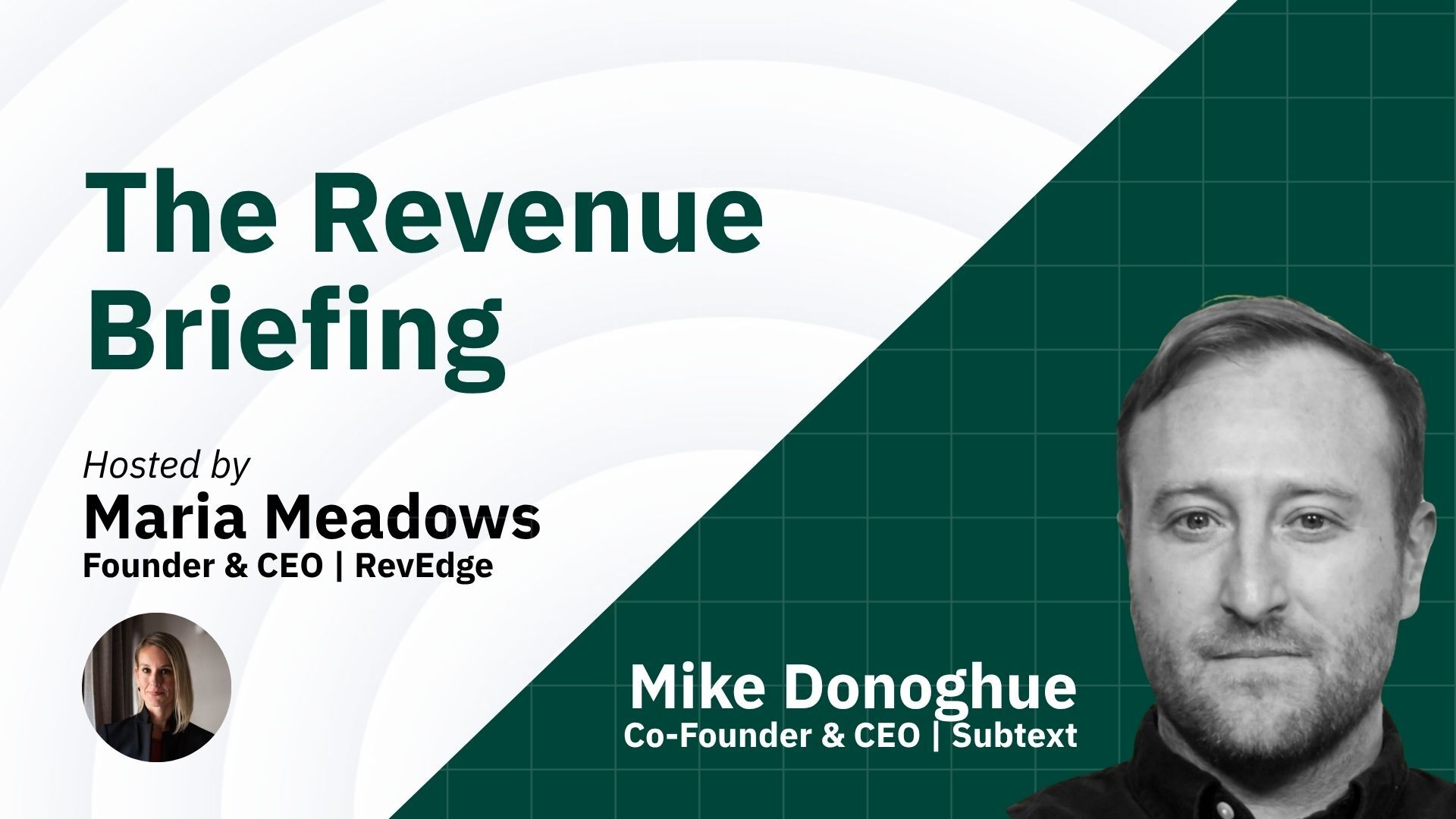
In this interview, Subtext CEO Mike Donoghue shares lessons from building and scaling a startup after beginning his career in frontline sales. Speaking with Maria Meadows, Donoghue explains how his sales background shaped his approach to leadership, product development, and company growth.
The conversation explores how sales teams act as a company’s most valuable source of market intelligence, how founders can avoid overly optimistic forecasting, and why leaders should stay closely connected to real customer conversations—even as organizations scale.
Donoghue also discusses how startups should think about product-market fit, hiring early sales teams, building a healthy revenue culture, and using data to detect signals in pipeline performance before problems surface.
For founders and revenue leaders, the interview highlights a consistent theme: the most effective organizations treat sales not just as a revenue engine, but as a continuous feedback loop that informs product strategy, positioning, and long-term growth.
Key Takeaways
1. Sales teams are a company’s most powerful market feedback loop
Sales isn’t just about revenue. Every win or loss contains signals about positioning, pricing, ICP fit, and product readiness.
2. Founders should stay deeply involved in early customer conversations
In early stages, founders often spend up to 95% of their time in sales and discovery, learning directly from the market before scaling the team.
3. Forecast problems often stem from unrealistic expectations
When founders set aggressive goals disconnected from market reality, sales teams may become overly optimistic in forecasting.
4. The best revenue leaders analyze lost deals as closely as wins
Understanding why deals were lost—at what stage, against which competitor, and with which buyer—reveals critical insights for improving the sales process.
5. Healthy sales cultures require psychological safety
Teams must feel safe sharing honest feedback—even when the product, positioning, or pricing isn’t working.
7. Leadership involvement should focus on enabling sales, not controlling it
Executives add the most value by helping reps think through deals, asking better questions, and providing strategic guidance.
8. Real-time revenue signals will become increasingly important
Modern tools should help leaders detect changes in pipeline health, deal progression, and rep performance before those signals show up in monthly dashboards.
Timestamped Interview Sections
00:00 — The Value of Honest Sales Feedback
Mike explains why strong sales teams provide candid market feedback—even when it challenges founders’ assumptions.
05:29 — Why Sales Teams Should Be Treated as an R&D Function
Sales teams gather critical market intelligence that can inform product development, pricing strategy, and go-to-market positioning.
07:03 — How Leaders Identify Revenue Signals and Market Patterns
Mike explains his approach to analyzing sales data: starting with high-level trends, then digging deeper to identify patterns across deals, teams, and verticals.
08:53 — Why Lost Deal Analysis Is One of the Most Valuable Reports
Studying lost deals often reveals more actionable insights than reviewing wins.
10:13 — Creating a Culture Where Sales Teams Can Fail Safely
Innovation and growth require a willingness to fail—and organizations must build cultures where teams can share failures openly.
11:54 — Forecasting Challenges for Early-Stage Founders
Mike explains why unrealistic targets and founder bias often distort sales forecasts in early-stage startups.
15:24 — Why Revenue Leaders Need Real-Time Pipeline Signals
Waiting for weekly pipeline meetings limits learning opportunities and slows down deal intervention.
18:18 — When Startups Should Begin Hiring Salespeople
Before scaling a sales team, companies must prove repeatable product-market fit and validate their ideal customer profile.
20:15 — How to Measure Sustainable Growth
Mike explains how leaders combine hard metrics (ARR, retention, close rates) with qualitative market signals to evaluate scalability.
23:23 — Where Founders Add the Most Value in the Sales Process
Mike prefers participating in early discovery conversations to learn directly from buyers.
26:43 — What Founders Learn from Their Sales Teams
Sales teams provide critical, sometimes uncomfortable feedback that helps founders refine their products and strategy.
28:59 — The Future of Revenue Intelligence and Sales Tooling
Mike discusses the need for tools that surface real-time signals from across sales data and convert them into actionable insights.
32:36 — Advice for Founders Building Their First Sales Tech Stack
Start with minimally viable tools, then scale systems as sales processes and teams mature.
Full Video Transcript
Mike Donoghue: Nobody ever tells you that your baby is ugly. But good salespeople, they will give you unfettered feedback.
Maria Meadows: Thank you for taking the time to interview with us. Mike, you are the CEO and founder at Subtext, but I think this is your second company. Yeah.
Mike Donoghue: Subtext is the second public company that we’ve spun out from what was the original tech incubator at a parent company called Advance.
Maria Meadows: That’s amazing. And so before I dig into my questions for you, can you give our audience a little bit of a background on your professional career, what you’ve built and what you’re working on today?
Mike Donoghue: So I’ll try and give you the Reader’s Digest version. It’s non-linear. Hopefully it’s like marginally interesting for your listeners. Okay. But yeah, so I actually started out in sales myself. So like doing tech sales many years ago and the most like entry level sales role, right? So some people can maybe commiserate. I was doing inside sales 125 cold calls a day, two and a half hours of talk time. Like that sort of you remember this? Yeah. So I was working for a company called career builder.com. At the time, maybe people remember it, maybe they don’t.
Maria Meadows: Anyone who came up from sales remember that sales environment for sure.
Mike Donoghue: It’s a common like trauma to bond around maybe. But a really important part of learning a foundational piece the way that I. View the business today and that sort of thing. So anyway, I ran a number of different business units for them. Ended up running east coast sales, operated in a variety of capacities.
Left, became the head of sales for a large branding agency on the east coast. So I got to do like all of the rebrands of the brands that you love. To love. So the FBI, the NYPD, Lockheed Martin, Raytheon a IG post bailout. So I did that for a number of years. Fast forward to more recently I joined Advance, I ran revenue strategy, mobile video, variety of the different bus corp dev functions, that sort of thing.
And then about. 10 years ago we were in our sort of normal like corp dev function, talking through how we operate the business units and maybe some areas of opportunity. And we came to the realization that hey, we do a really good job of investing. We do a really good job of operating our portfolio companies, but what we don’t do is autonomously build MVPs to meet market demand.
Yeah. And spin out individual businesses associated with that. So they said, Hey. That sounds like a good idea. You are in charge. I said, oh shoot, I’ve never done this before, but I’m gonna figure it out. Fast forward to today, like we’re on our second product we’ve been scaling the team revenue is at an all time high.
We’re up a hundred percent year over year and continuing to grow. Yeah, it’s been a while ride, but really fun one.
Maria Meadows: And it’s rare that you hear. A technical founder come up through sales. I think 86% of our founders come up through engineering or operations. So it’s gonna be a real treat, picking your brain today on running a business and also building a growth strategy, managing resources to drive growth.
But I do appreciate where you came from. ’cause I always say if you’ve been. Out and develop new business, like the old days in terms of cold calling and hitting the streets, I think you can pretty much do anything.
Mike Donoghue: It’s true. You said you set the bar for pain very high early on.
Maria Meadows: So before I start picking your brain on running revenue or overseeing a sales organization, can you give the audience just a quick overview of your, how you would describe your leadership style?
Mike Donoghue: Yeah. My hope is that my team would describe it as empathetic, right? I think, for any of the roles, because being a co-founder means that you are there at the earliest stages, right? So I’ve been involved in doing our billing, doing customer service building, like prototypes for products, talking with engineering around, the way that we’re going to.
Create databases and that sort of thing. I’m fortunate enough to have been there from the beginning. From a, from an empathetic standpoint, I try and put myself in the shoes of anyone on the team. And what I love about the business and what I love about building businesses is like the opportunity to really roll your sleeves up and get your hands into the dough, so to speak.
And that’s a really exciting thing for me is I’m, I don’t. Exclusively judge outcomes necessarily. I really, I’m somebody who very much wants to get into the inner workings of like how we arrived at that outcome. Yeah. And what we might be able to do to optimize or otherwise learn from every step in the process.
Maria Meadows: Yeah, I love that. And I wanna come back to process here in a minute. ‘Cause you don’t hear that often from. Many sales folks that have come through the trenches, and I’m sorry that I keep locking into the fact that you have a heavy sales background. It’s just a treat for me to work with someone that and a much of appreciation of someone that started in sales and actually is now a technical founder too.
So you’re a little bit of a unicorn in my eyes. So let me just geek out with you for a minute. But if you think about pivoting from each of the hats that you’ve worn in the organization and building the company from the ground up. When you moved from founder-led sales, how did you view the role of sales early on, and how has that perspective changed as your role has evolved and your organization has grown?
Mike Donoghue: Yeah, so sales, I think the really common adage is oh, you know what? Sales is our engine, right? And they’re a driver of growth and they’re certainly obviously the primary contributor to revenue and that sort of thing. But like one of the other things that’s always really important to me, running a sales team.
Is making sure that we’re getting as much market feedback as we possibly can, right? So like I look at it not only as sales and we’re driving revenue and market share growth and like margin and new logos and that sort of thing, but this is also like partially our r and d function as well.
Meaning like what are we hearing from the market? If we’re getting a lot of the bats, then maybe we’re obviously gonna like swing and miss on a handful of those, but why did we miss. What could we improved? Is it our positioning in the market? Is it our pricing? Is it our ICP? Is it going to be, who we’re calling on ultimately the timeliness of the calls, like that sort of thing.
It’s really important to understand not only, hey, did we win the business or do we not win the business? But in the event that either one of those things happened, why did it happen and how can we learn from it and how can we optimize against it going forward?
Maria Meadows: So what is the process then? Because when you’re at the level that you’re at with the organization that you’re at, there’s a lot on your plate.
So how are you processing, getting in that level of detail with the organization, with the sales team, and balancing those conversations and that time that it takes to get that intel with running business, for lack of better words. So what is your process? What’s your approach to doing that? What do you recommend for others?
Mike Donoghue: Yeah. It is a great question. So what I’d like to get the sort of approach that I try and take is, first we start with kind of the high level reporting, right? So what are the broad trends that we’re seeing across the sales team in individual verticals, maybe at, certain deal stages, that sort of thing.
Are we winning the business? Are we progressing? Are we not progressing? So I try and use my dashboards. I try and use my rev ops team and all the tools that we have available. To us. Yeah. Identify hey, here are the broader patterns, right? Or here are the broader trends that we’re seeing Then yeah.
I think it’s really important to dig in a layer deeper, right? Yeah. And get a feeling for, okay, so amongst these individual trends, here are the patterns that exist associated with each one of them, right? So if we go a layer deeper and we say, okay, you know what? Maybe our time to close in vertical A has gone up by 30%.
Okay, let’s dig into it. So you know, why are, what are some of the reasons why. Ton of close has gone up. Is it a pricing issue? Is it a technical issue? Is it, our ability to go to market? Are we stuck in InfoSec review? Like all of these things. So without getting into the the finite details of every single deal, because I think that could be misleading and skew your view of the way that these systems work, you need to start at the top, go a layer deeper, ask the questions.
That are important to ask and obviously get like the honest unfettered answers and then start to piece together the patterns, right? Yeah. So are we seeing it across multiple verticals? Are we seeing it across multiple sales team members, that sort of thing?
Maria Meadows: And so what does that structure look like? So you have the luxury of having the rev ops resource, I believe you use Salesforce as your CRM, is that right?
Mike Donoghue: Yep.
Maria Meadows: And so they’ve built certain reports and dashboards for you. Do you have a favorite or one that you really check most frequently compared to other reports?
Mike Donoghue: Like I don’t, I have two kids. I don’t have a favorite kid. But they’re independently good at different things. So we build, we end up building because of the nature of our business.
Like a lot of custom dashboards. But one of the things that I always find really insightful. Is I’m sure the sales team hates this to a degree, right? Because we end up studying a lot more is the report that gives me a breakdown of the deals that we had lost, right? And I wanna understand why we lost them, at what stage to whom, if it’s in a competitive scenario, what the TCV was, what sort of the projected a RR was, who our buyer was.
Because I think that’s painful. As it can be to revisit your losses. There’s so many valuable insights in there that to not mine it appropriately and just to like whitewash and be like, oh, we’ll get ’em next time. Maybe we won’t get the chance to get them next time. ‘Cause we didn’t understand what we did wrong the first time around.
Maria Meadows: Yeah, I think it’s so important to focus on what didn’t work and have those honest conversations and then you learn so much more from that exercise. The way you lead the organization too makes it a safe place to have those discussions. And it’s also clear on how you view the role of because they’re not a function of distribution.
They’re a key, to your point, an r and d arm for the business. And so this is where you really learn on those losses too. It makes it safe to really empowering for the leaders too, to do.
Mike Donoghue: I can’t stress enough the point that you touched on, which is like you do have to create the culture.
Where it’s okay to fail, right? We talk to people. I talk to the team a lot about this and we talk about it publicly too, is if you have the appetite for growth or the appetite for innovation or risks taking or whatever it’s going to be like. You also very much have to have the stomach for failure.
And I think like when those two things get like disproportionate or like too far out of whack, it creates a scenario where like you can’t get as much information or as like much unfiltered information as you might want, and it just makes it that much harder to run the business.
Maria Meadows: Is that a similar philosophy and approach that you had in the early days?
And the reason I ask that question is there’s a lot. At stake in the early stages of a business. And there’s a lot of investment that goes into sales, whether it’s one hire or two. And I’ve seen a founder move away from running sales s like wearing in the hat of CEO only, and hiring their first sales hire.
We tend to see there’s a lot of emotional bias in the forecast, and we hear from some of our founders that it’s hard to filter that out in these early days because. We’re moving very fast. The road to growth is chaotic. There’s a lot of pieces that we’re learning and fine tuning, but at the same time they are signaling to us, they’re telling us they don’t have a confidence in the forecast that they’re getting.
And you’ve been there and you’ve done that. So if you had advice to any early stage founder what advice would you have for them in those early days and how do you create that culture? How do you get that honest feedback where you feel confident in forecast or the direction the business is going?
Mike Donoghue: Yeah. I think so much of it comes back to the empowerment of your sales team and the culture that you build with the sales team. When you start getting sales forecasts that are so far detached from reality. It’s oftentimes because you, yourself, this is my opinion, and I’ve been at fault for this before, but if you are attaching unrealistic goals, let’s say to the sales team, or you as the founder don’t clearly understand the market, or you haven’t done the research, or you haven’t been on enough sales calls yourself, I think it’s really easy to look at, let’s call it tam, right?
And yes, sales resourcing. And activity and apply a metric to these things. And it’s okay, we should be growing at X, Y, or Z. But like the market is not dictating that you’re growing at that pace. Yeah, or like in that cadence. And I think more often than not, what happens is, sales.
Sales is really good salespeople. They’re competitive. They want to succeed, they want to meet or exceed goals. When you set goals that are unrealistic, they’re going to do their best, obviously, to get there. And I think, even if it means in some instances, like maybe being overly optimistic about the size of a deal or the nature of a deal, and I think a lot of that comes down to, the appropriate goal setting. And then making sure that the team feels empowered to be able to tell you the truth, right? Because there can be a really massive power imbalance, right? And I’ve seen a lot of very early stage founders that are like, Hey, I’m hiring the sales team and you guys are the experts and I’m gonna wash my hands of this entire thing.
And sit at my dashboard, right? And just make decisions based on the dashboard. When candidly, like if you were to get out and better understand, what the sales team is hearing, how they’re approaching the market, you might be able to help, you might be able to optimize, but I think you get a much clearer vision for what the market is actually telling you.
Love that. Without it having to go through, the emotional lens of the sales team.
Maria Meadows: So how do you balance then knowing when to get involved at the deal level or how to collect that field feedback with running the business?
Mike Donoghue: Yeah, I mean I try and defer to my sales team and I’ll give them like a quick shout out ’cause they’re amazing.
We actually are first salesperson besides like the co-founders and stuff. Yeah. The first salesperson that we hired is still with us today. Like these many years later. He’s crushing, he is great guy. Josh’s name, but the balance here is really you have to defer to. I think as a leader you have to prove value to the sales team, right?
Like they have to view it as valuable that, if you are invited to join a call, you can help them close it. You can help them progress it. You can help them do more due diligence. I’ve seen scenarios, I’ve been in scenarios where I was a salesperson and leadership. Wanted to, join our sales calls and I was more nervous about them doing something wrong or like them otherwise, and like the deal.
So it’s like I try and defer to the sales team, right? And have them tell me like, Hey, if you have a big opportunity, if you have an area where you think I could add value, I absolutely want to be there. Invite me. I’ll do my best to not embarrass you. And we’ll try and keep things on track. But otherwise it’s a matter of making sure that you’re getting the regular pulse of what’s going on amongst the sales team. If that’s in your dashboards, if that’s in your reporting, and in a more empirical way than just Hey, sat in on these 10 calls and seven of them went well, three didn’t.
Maria Meadows: I think that is so important, and you mentioned you framed it as a pulse that to me is so critical in really unleashing your talent and establishing that culture is what are those signals you’re evaluating, whether it’s through your dashboard or other reports or even the questions you’re asking.
But I think there’s gotta be a shift for business operators to go from that once a week forecasting meeting where you’re getting the readout to listening in and asking the right question because I think that trust and that credibility and even the coaching happens at the deal level internally, not necessarily always in the field.
And so what I mean by that is if you get a signal, sit down with a rep and talk through the deal strategy and brainstorm, and I think it gives the rep the opportunity to hear you think. Yeah, out loud, and sometimes that’s all you need. It may not be, I need you to get the feel from me, but I just want to hear you think out loud because you know this so much better than anyone else in the company.
And I think it’s an untapped opportunity for most executives of they’re a wealth of information, but they’re very busy.
Mike Donoghue: Yeah. And so much of it too, like you captured it really well, right? Is that if you rely on weekly pipeline meetings, that sort of thing, and that is your only exposure to what’s going on, with the sales organization or with individual salespeople.
You really, if you’re lucky, you only get 52 teachable moments. When in reality, I think, if you had a tool that could provide you those insights that you know you were getting the appropriate signals and you could go in and maybe not interfere, right? Not me, but ask the right questions or provide the right guidance, or even just make a small tweak.
I can’t tell you like how big of a difference and how big of an accelerant. It would be for not only the sales team, but for you as the leader. Because we’ve all been in the weekly pipeline update meetings and it’s I’ve got this, and this. And it’s like, how can I help?
Okay, we’ll do these three things like great and it’s done. But being able to. Be a part of it in real time at that level is hugely important and can dramatically change the trajectory of the business, right? If you get 300 chances to teach people, if you get 400 chances to teach people, it doesn’t have to be an hour long meeting, but it can be like a really meaningful moment where you change the course of that salesperson or that deal, or you know the business at large, but you need the signals.
Maria Meadows: Oh my gosh. I’ve never heard it framed as only 52 teachable moments. I think that’s when you think about it in context about how many business hours we dedicate to work. Yeah. And then across the team, that is such a great point on how many other missed opportunities are happening. Or available to us in the day to day.
So you mentioned your stellar rep, and I wanna, I won’t keep having you call out his name by chance because we know we’re all gonna come recruiting him. But other than your top performer, how did you know it was time to move to additional hires?
Mike Donoghue: Yeah, so I think for us it’s really more a matter of have we so number one, have we proved.
Product market fit beyond like a reasonable doubt, right? Because I think like a lot of good passionate founders can mask a weak product market fit, right? Because in so many early stages, I think if you’re a founder who really believes in something and you know it to a degree, like it depends on what it is that you’re selling or what you’ve created or the business you operate, that passion tends to rub off on people and I think you’ll get people that will make.
Speculative bias of the product. ’cause they’re like, Hey, you know what? This person really believes in it and maybe they seem really sharp or, they’re really passionate about it. I’m willing to take a flyer on this. But it’s not until you have that strong, the strong indicators around PMF and a repeatable pattern and like a strong ICP that I think you can reliably hire salespeople and then measure.
Their performance. Because we’ve all also, from a sales standpoint, been in this scenario where it’s like we’re trying to sell something that is just not ready for market yet. And, tries you might to like, get it out there and every best effort and everything else, it just, it doesn’t take root.
And, candidly, that’s not a reflection on, the salesperson or their ability. It’s a reflection on the product. And I think until the product is ready, it’s hard to scale it with a sales team ’cause you’re gonna get frustration. You’re gonna get people that churn and then, you lose a lot of like organizational knowledge and it’s just like continually starting flatfooted.
Maria Meadows: I love that. So how, speaking of that acceleration point, how do you determine what’s healthy growth within the business in terms of readiness for scale? Because to your point that I think there’s some early wins that can happen. But that repeatability as a signal is so important. But then how do you qualify that this is sustainable growth?
Mike Donoghue: Yeah, so sustainable growth. There’s obviously I, so I look at it two ways. You’ve got your sort of hard metrics, right? So like gross revenue retention, net revenue retention, individual, a RR on deals and like time to close and like all of the things that like sales leadership is used to reviewing in a dashboard and churn metrics and like that sort of thing.
And then you’ve got the more. Qualitative signals around Hey, for example, if we win a piece of business in this particular vertical, are we able to make a really strong case to maybe the very similarly situated businesses that they might want to come on board? And it can be really early stage things like, is our cold outreach performing well, right?
Are we booking enough meetings? Are we positioning this the right way? Are people viewing. This as like a meaningful opportunity? Or is it like more of a curiosity and like you really need to qualify these things, right? Is your product a need to have? Is it a nice to have? Is it a kind of cool speculative like pilot type thing?
Who are the buyers? What do they buy? What are the goals in implementing it? Those sorts of things that you know might not always show up. In your charts, it really comes down to a combination of those two things. Like what you’re hearing in the market and what you’re seeing in your forecasting and your more qualitative tools.
Maria Meadows: What percentage of your time would you say you dedicate toward the sales side of the business? It would be interesting ’cause you’ve managed to scale repeatedly, so early days, percentage versus now. Has it changed?
Mike Donoghue: 95%, right? Because without real traction in the marketplace, without client feedback, without even sitting in on those discovery sessions and learning like, Hey, are we asking the right questions to the right people?
Is what it is that we’ve created as a minimally viable product here? Is this hitting with folks? Does it resonate? Does it make sense? Do they need it? Do they want it? And can we get it through the purchasing process? Obviously that 95% of the time has to scale back and I’m really fortunate, right? I have amazing co-founders to A CTO, A-C-P-O-A-C-S-O and a really strong leadership team that we brought in that I’ve worked with for a long time.
But that scales back. So maybe it becomes. 50% maybe becomes 45 or 40. But I’m still, and maybe this is just like a psychological flaw in me, or this was like beat into me when I was doing inside sales, but it’s the sales part of this business is the really exciting thing to me.
Like we can all sit in a dark room and create PowerPoints and that sort of thing, and like hopefully people love them. But at the end of the day, like there’s no better way to test the validity and get real market feedback around what it is that you’ve built until you take the mark and see whether or not somebody’s willing to pay for it.
It’s, maybe it’s 40, maybe it’s 45, but like it’s still, that’s probably a personality flaw in me. It’s just something that I select to do.
Maria Meadows: Do you, is there a part of the sales process that you tend to gravitate toward more? Do you like to be in on the business development early discovery sessions, or do you like to get in.
On the back half scoping, negotiation part of the process. Are you in on all of it still?
Mike Donoghue: I’m always happy. To my earlier point really depends on, when the sales team wants to bring me in. But like I’m a big, and we try and instill this in our sales team too, like I’m really.
Intellectually curious about these things. So I actually love the, even like the earliest stage discovery sessions. ’cause it’s not often that you get to sit with, business leaders or executives, people that would be maybe buyers of your product and ask a lot of insightful questions.
There’s so many learnings tied up in those discovery sessions that like. Sometimes to not be a part of them puts you at a particular disadvantage at a later stage in the process, right? So right. You can come of we’ve all had those scenarios where maybe negotiations have stalled out a little bit and they’re like, oh, here comes the co-founder, the CEO, and they’re gonna hardline the negotiations.
And it’s there’s nothing, in my opinion there’s nothing more offputting in my opinion than having somebody parachute in who is not familiar with it at all. And this is from a buyer’s standpoint, as somebody who buys a lot of software products too, for our business. It’s a little insulting to have somebody come in at the final stage of the deal and be like, I’m just gonna jingle my keys and you are gonna agree to like what it is that like we’ve discussed previously.
It’s no, like your salesperson did all the hard work here. If they understand the business allow them to do, allow them to make their best, provide their best guidance based on, their due diligence that they do with our business.
Maria Meadows: So much of that. I always say you don’t lose a deal because of pricing.
Something broke earlier in the process. So I love that you’re focusing more on the kind of the early stages and the questions there. I think it’s a really important piece that I think over gets overlooked. ’cause we just assume we hire a right SDR, we’ve got a good lead gen funnel and we’ll get involved if we need help with negotiation and scoping.
But there’s so many missteps and missed opportunities or some early signals that we could preempt.
Mike Donoghue: I think like it being involved in the early stages can very much help you rightsize the opportunity too. Again, like we’ve all had, a similar situation where it’s like we came in and we asked, maybe we just got lucky and we asked two or three questions just off the cuff and we got a response and we’re like, whoa.
The scale of this opportunity could be so much bigger if we took a step back and thought about it in a different vein. I think as a salesperson, oftentimes it’s really easy to get tunnel vision. It’s like rinse and repeat. I’m selling the same thing over and over again. When in reality, especially as your product matures and as the need for it grows across different business units.
Taking a higher level view of what the scope of the opportunity looks. So I can ask the right questions if the right person can really take, it can take a deal that was maybe of average size and make it a much more significant one.
Maria Meadows: That’s a great point, and definitely shorten the sales cycle for sure too.
So what would you say when you pivoted to starting to build out your own team and hiring resources underneath you? What did you learn from your sales team? Did they teach you anything?
Mike Donoghue: They teach me more than I think they probably know or want to be teaching me. More often than not. So much of it too, right?
Like when you’re a founder, I use this phrase like, not totally adjust, but like it’s kinda like being a new parent. So you’ve got this special thing, this miracle, this thing that you’ve created and like you’ve basically, you’ve beat every conceivable odd to be at this place, right?
So you have a viable startup. Maybe you have like really early stage product, market fit and that sort of thing. And the hardest thing to ever, nobody ever tells you that you’re baby. Is ugly, right? But good salespeople, like worth their metal, that are confident, that are empowered, that are going to market, they will give you unfettered feedback about what it is that you are hearing, right?
So if your baby is in fact. Ugly. Like it’s better to hear that really early on than two years down the road where it’s like, Hey, why can’t we get traction? Or why are we churning out all of our clients? Or why is our deal size not, the way that we had, the scale that we had projected it would be.
More often than not, it comes from not learning enough about it, not stress testing it enough in the market and not having people that were willing to be candid with you early on. So I think our sales team, they teach us a lot of that, right? It is here’s what’s working, here’s what’s not working.
Yeah. Here’s where we may need to pivot. Here’s what we can lean into as a founder. Those are all hugely important pieces, and I’d just like to caveat. For my two kids, neither one of them is ugly. Nobody’s ever told me they’re ugly. But they’ve achieved optimal pro. They’ve achieved optimal product market fit, Maria they’re crushing.
Maria Meadows: I love that. So if you think about the business for you as it stands today and all the tools that are coming out in the market. You are pretty resourced, right? You’re fortunate to have a rev ops leader who, yeah, from what I’ve heard is wonderful and on top of it with all the different dashboards and can populate reports real time for you, what do you wish you could see sooner?
Are there any tools that you’re looking at that would be valuable for other founders like yourself?
Mike Donoghue: What I like and you referenced it before, right? We use Salesforce and we use Gong and, a whole variety of tools, right? And all really valuable tools and like an important part of our tech stack and that sort of thing.
But more often than not I feel like what. I’m missing, which is what I would like to have is the ability in relative real time to be able to take like a quick pulse of like individual deals, individual reps, individual verticals, and just get this doesn’t have to be me calling somebody up at midnight and being like, Hey, what is going on with deal A, B, C, A way to distill all of the insights that exist in any of these dashboards and then get quick.
Pulses and hopefully maybe even, in the future, be able to dig into what those are telling us or, is like, deal rod, have we passed, the close date on this many deals? Or do we have like certain deals that were really important previously that are now stuck or has have our projections gone down for previous deals, like things that might get lost.
In the dashboard. Yeah. Where it might need like real time tending to again to wait for Hey, here’s my monthly dashboard, and then it’s 30 days later and you’re like, oh, shoot.
Our pipeline’s down like 20%. That’s not good. If I had known earlier, I would’ve maybe been able to intervene.
Maria Meadows: Yeah. And I think some of you’re lucky, you’ve built a culture and. It’s not just tooling, right? It’s also leadership and it’s how you get involved in the business and when and where and how the team gets involved. But that, that very real time, and that’s gonna be more and more pronounced with all the AI tools out there.
There’s gonna be so many different signals coming from all these tools. Totally. How do you interpret them? How do you prioritize? Where do you invest? Do you, of the tools you’re using today, do you have a favorite? And if someone came up and asked you as a founder starting a sales organization, what do you say outside of the CRM?
We know that’s an obvious, do you have one that you’re like, this is a must have?
Mike Donoghue: No, it’s a great question. I guess it depends on the definition of tools. I find something like Claude to be hugely invaluable, right? ’cause that’s my interpretation layer. Like we can build around, we can build via Claude, we can create a lot of insights and maybe unlock a lot of information that was otherwise like tied up.
In like disparate systems and that sort of thing. But Claude, like any AI tool, right? Like it’s only as good as the inputs ultimately, and it’s only as good as your ability to use it. So I think, yeah, we have a lot of favorites. We have a lot of really valuable tools. I think the ones that the commonalities of around the ones that are the most valuable are the ones that.
Take a smart, informed distillation of a lot of data, provide actionable insights to me or anyone else on the team who might need them, and give us a way to affect change or capitalize on those insights in a really quick sort of bite-sized way. Yeah. I think that’s the real commonality. Those are the winning solutions.
More often than not,
Maria Meadows: and you’re opening up so many doors of conversation for me. Sorry, I’m trying to be mindful of your time, but a quick question for you, balancing a lot of questions that we get on the consulting side is when do I know when to hire? What do I put first? The tools, the individuals. Do I wait for sales to tell me what they need?
Where do I need to start? So there’s just so much noise coming outta founder. So many decision points really, between the talent, the processes, the tools, what advice would you give them?
Mike Donoghue: So I really look at it like this. You need, look, if you have no salespeople, you do not need a $200,000 a year implementation of Salesforce.
Despite, and I know a lot of people at Salesforce and they have great sales teams, they do a really good job. You do not need that, right? So the question is the first thing you likely need in any scenario, and you should be doing this even as a founder too. It’s what are my minimally viable tools?
What are like the handful of things that I need to not just pull my hair out while like I’m trying to keep all of these different plates spinning and then from there we have our minimally viable set of tools and we think, we can track things, we can identify patterns, we can learn from what it is that we’re doing in market.
Then from there. I think it’s people and the people help you refined or create like demand around your tools going forward, right? Because you can over-engineer a rev ops tech stack really early on and hire a bunch of salespeople and be like, Hey, here’s the tech stack. Go build with this thing.
You might end up investing a lot of money in a lot of tools that maybe people don’t find useful or too cumbersome or not beneficial. So it’s really hey, look, how do we start with the minimally viable tools that do you know exactly what we need them to do? Then how do we stress test them with a sales team and like higher volume and that sort of thing.
And then slowly graduate to, the enterprise grade solutions Yeah. Sort of thing.
Maria Meadows: So that would be definitely starting with A CRM and then potentially what automation tooling or a CRM with automation.
Mike Donoghue: I think like even a, lightweight CRM, but it like, to me it pretty much has to have some level of automation because it’s just, you’re never gonna have the time to manually reconfigure the CR M or get the dashboards you want because you presumably also don’t have a rev ops team or analytics team.
So it’s like a one person show. So I think the more in the early stage tools, like even the lightest weight CRMs. The more automations you can have or just the lightweight layers that can provide actionable insights out of what’s being put into the CRM. Yeah, just to identify patterns, like that’s hugely helpful.
Maria Meadows: And then what do you think about call listening tools in the early stages?
Mike Donoghue: Yeah, I know some people find them like Orwellian. I like, I totally understand that. I think the. Call listening tools are good in so much as you do something meaningful with the insights, right? Yeah. If you record every single call and you’re doing X amount of calls in a given day or a given month, like there’s a tremendous amount of insights.
So the question really is like, how do we, again. Identify sort of the patterns amongst all of these calls. ’cause like just listening to a single call and then Yeah. Over ascribing too much value is probably like a little tunnel vision. Yeah. But if you listen, transcribe and then get actionable insights from like patterns that emerge amongst all of those call listening tools.
I think that’s really interesting.
Maria Meadows: Yeah, I do too. It’s also helpful from a rep’s perspective just to capture action items a hundred percent. Those are so complex right now. So being in the moment of running the meeting, strategizing with a prospect and trying to capture all the notes at the same time, it’s just not practical.
So I think it is a really great value add administratively for them at least. But to your point, and I haven’t even thought about it, of just that, the data insights that are available there of just patterns.
Mike Donoghue: Yeah. And that’s to say nothing of running a really robust discovery call too.
Yeah, and getting to go back to your notes and be like, Hey, you know what, like maybe we ran an amazing discovery call and we got a tremendous amount of insight. Nobody’s ever, especially like an individual sales person with nobody else there, like nobody’s ever going to be able to capture like all of those insights.
So being able to go back to the call. Listen to it again and like really hone in on what was top of mind. For that prospect only makes you know the next stages of your deal that much stronger.
Maria Meadows: I think it’s such a beautiful point. I don’t hear founders often talking about being and founders is loose.
I most operators with everything they’ve got going on. I don’t find them often focusing so heavily on the discovery. Portion of the process, and I think it’s so important to your point, I have so many great takeaways from this conversation, but I definitely think one of ’em is the earlier you’re involved or how you’re paying attention to how your team is asking the right questions and understanding could open up a lot of opportunities, whether that’s understanding of the product.
The ICP, how they’re prepping for the meetings, how they’re supported in the meetings, and thinking about and uncovering key opportunities to motivate the sales cycle versus getting involved in the back half when either there’s a fire or we’re stuck somewhere in the process.
Mike Donoghue: Yeah, I I look at it like this and like maybe I’m placing too much importance on what it is that we do day to day, but if I went to a doctor and that doctor didn’t do any diagnostics on me and didn’t ask me any questions or anything like that, and they were like you look like you know this type of person. I’m gonna write you a prescription for this thing, and be like I don’t know if I want to take this prescription.
You haven’t done any sort of testing. But if they were like very thorough and they were very engaging and they were like, oh, we have to run these diagnostics and whatever, and they prescribed a solution for you. Yeah. I think like you would be much more trusting. You’d be much more apt to Yeah.
Take their advice. And the same thing, bringing somebody in at the early stage God forbid something terrible goes wrong, like
I sure hope my. Brain surgeon has read my charts before they walk into the room. So it’s an important, it’s a really important facet of this process.
Maria Meadows: It really is. It’s one that I think we should all focus on more. And I think it’s such a aha moment in the conversation today too, because you do, even from a tooling perspective, to tie off to the, to my previous question, there’s a lot of tools focused on the operator for forecasting. How do you better forecast the business?
How do you better qualify the forecast? And, it makes you question that’s probably too late at that point, and is that where you really should be spending your time and your dollars? Or is there an opportunity to be more preemptive with the organization and what those processes are early in the prospecting sales process, then waiting.
Mike Donoghue: Totally agree.
Maria Meadows: Okay, so what’s next for you? You’ve felt. An amazing product. You’ve scaled an organization, you’re exceeding your number. What’s gonna keep your brain busy? Next, I know we’re just closing Q1, but for this year, in terms of priorities for the sales organization, give us more of a point of view from a scaled founder perspective.
Mike Donoghue: Yeah. So for us it’s really so three facets of like things that we’re working on at this point, like in the business, right? One is something that we always work on, but the landscape and the backdrop against which we do this work consistently changes. But like one, making sure from a product, from a technology standpoint, that we continue to be technically differentiated in the market.
It’s easy, especially when you get to a certain stage to be like, we’ve arrived. This is the product and we are just gonna put it into market with as much force as we possibly can, and we’re gonna scale that way. And I think a lot of good organizations die a very slow death when they’re not focused on continual technical differentiation of the product.
So that is one very important piece for us. The other one is using. The tools that we have available to us or might exist out there in the space to one, learn more about the business and our prospects and like the work that we’re doing, our sales team, our CS team, our marketing team, and using those tools to improve our efficiencies.
I think that’s a commonality amongst most businesses right now. It’s like, how can we leverage technology? To create efficiencies to be stronger, leaner, healthier, more dangerous in the market. And that makes a ton of sense. And then the final piece is just continuing to scale growth in a sustainable way.
We wanna continue to reinvest in the facets of the business that are proven to be profitable. And favorable and where we have a lot of tailwinds, but also to make sure that we earmark certain money, certain resources to invest in emerging portions of the business. Is there a corner that maybe by virtue of what it is that we do that we can see around that maybe other people don’t see around?
How can we experiment? How can we invest there? How can we create an additional maybe MVP to test the viability of. A new revenue stream or a new leg of the stool. I think if we were gonna cap it off high level, that’s probably like the right way to look at it. But for us it’s just like, how do we continue to be students of, our own product and the markets that we serve and our business and our team and just get smarter and more efficient about what it’s we do.
Maria Meadows: Yeah. How do you determine, when you think about that third leg of the stool for investing more and diversifying your revenue? And I love that you started more on the differentiation, right? Because that needs to happen first and saying, continuing to invest in your differentiation before hiring more sales resources, right?
And they go hand in hand candidly, but the, with the sellers a big question we often get is. Who do I hire first and how do I know what type of salesperson I need? So for you, at your stage of growth, right? You have some really great sellers that are very tenured and have been with you for a while and had another space, and now as you think about diversifying or potentially accelerating growth, where do you start?
Is it SDR? Is it more AEs? What type of skillset are you looking for?
Mike Donoghue: Yeah. So a great question. We when we do scaled growth of yeah, the sales team, for example, we actually try and do it in a full cross section of each one of the roles. So like we don’t just look at Hey, we’re gonna plow a bunch of money into the AE function or plow a bunch of money into the SDR function.
We actually try and do, if you consider it like director, ae, SDR, like we try and do all three. And then scale it from there, because I think, there’s certain deal types that maybe directors are gonna be focused on or certain conversations they’re having that are hugely important.
Same thing with AEs and obviously our SDR that we have is amazing. She’s done an incredible job of two divest in that function at the investment opportunity of another function is a mess.
Maria Meadows: I’m just so excited about it because I do think that it’s more of a pod function, right? It’s a team and everyone has their strengths at different stages of the process.
And I think it gives you more scale when you think about each individual resource and how they work together. But how they work independently, I think would give you more of that force multiplier than making a decision of, okay, SDR ae now of course, you’re in a different stage, right? So there’s, trades and compromises there that, but I do think it’s important to think about the function that each of these resources serve, and I think the complexity of the sales. Market today is no longer one salesperson or one individual can do it all at the pace that we need to see.
So you probably do get more ROI investing. I love that
Mike Donoghue: A hundred percent.
Maria Meadows: Thank you so much. I could keep picking your brain all day long, but I really appreciate it. I think there’s a lot of really great points here and it’s really energizing to see a CEO and a founder involved at this level with the business, but also building a system that enables you to.
Kind of build for the future, but also execute in the now and establish a culture. So there’s a lot of big themes that we hit on today that I’m excited to highlight. And a lot of, reinforcement points that I think I’ve personally gotten away from too, because I tend to gravitate more toward the bottom of the funnel and react there.
So it’s just great to think about what happens early on in the process, but also a balance between the people, the coaching and the tools too. Keep operating. So thank you so much.
Mike Donoghue: Honestly, the pleasure’s all mine. This has been so much fun. I really appreciate you taking the time and hopefully this is valuable, but I got a lot out of it personally.
I think it’s great.